
501(c)(3) Processing Time: What Founders Need to Know
If you filed Form 1023-EZ, the IRS issues 80% of determinations within 22 days. If you filed the full Form 1023, that benchmark stretches to 191 days. Your first move right now: visit the IRS “Where’s My Application” page and confirm your submission date falls before the posted processing cutoff.
About one in five applicants fall outside those windows because of complexity, workload variability, or IRS follow-up requests. A clean, complete submission is the single most reliable way to stay in the faster majority.
Form 1023-EZ: 80% of determinations issued within ~22 days; flagged cases can take up to 120 days
Form 1023 (full): 80% of determinations issued within ~191 days; complex cases often run longer
Immediate action: Check the IRS “Where’s My Application” page, note your submission date, and search your organization on Tax Exempt Organization Search (TEOS) to confirm whether a determination letter has already posted
Key Takeaways
| Point | Details |
|---|---|
| 1023-EZ vs. full 1023 | 1023-EZ averages ~22 days; full Form 1023 averages ~191 days for 80% of applicants. |
| Check status correctly | Confirm your submission date predates the IRS processing cutoff before calling or writing. |
| Top delay trigger | Missing purpose or dissolution clauses in organizing documents prompt further review most often. |
| Expedited handling limits | Expedited processing requires written justification and is not available for Form 1023-EZ filers. |
| Chisholm Law Firm’s role | Chisholm Law Firm reviews submissions for accuracy and handles IRS responses to reduce review time. |
Table of Contents
How to check your application’s status using official IRS tools
Top reasons 501©(3) applications get delayed — and how to prevent each one
When expedited processing is available and how to request it
If your application seems stuck: when to escalate and what to prepare
Chisholmfirm’s experience with 501©(3) timelines and what it means for your case
What happens to your 501©(3) application after you file
Understanding the IRS review pipeline helps you set realistic expectations and catch problems early. Here is how the process typically unfolds from submission to determination letter.
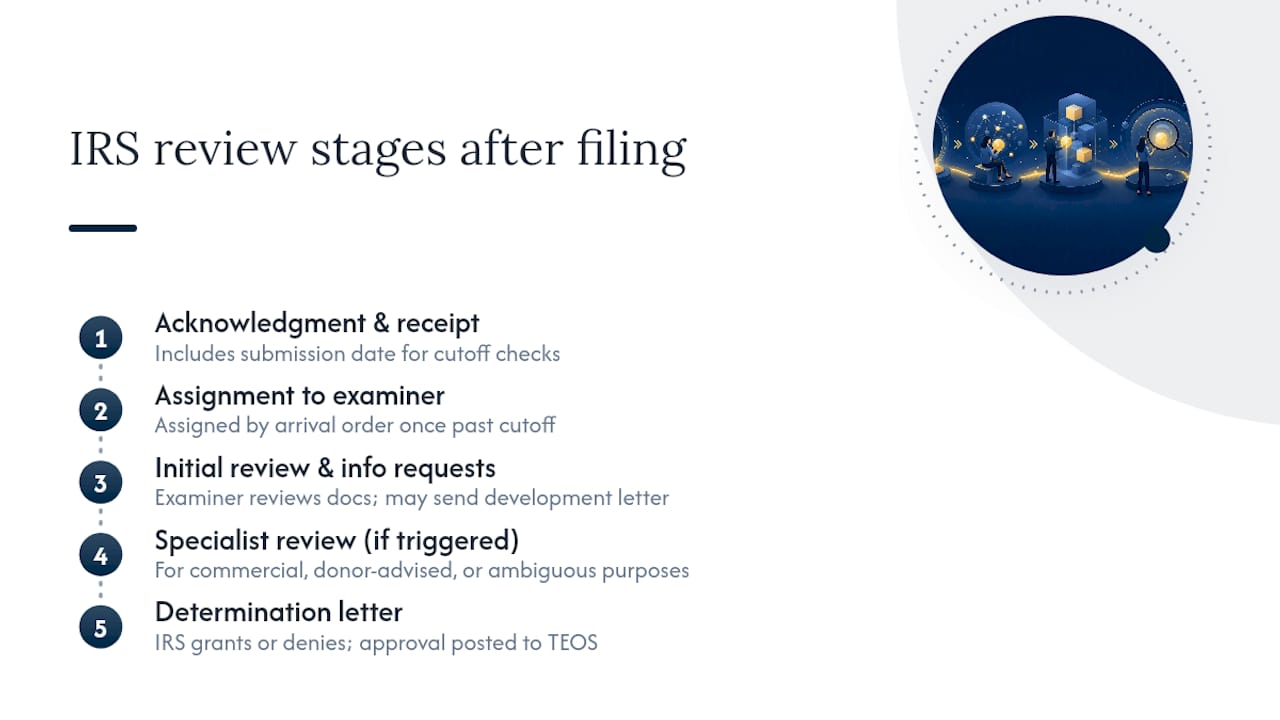
Stage 1: Acknowledgment and receipt
After you submit electronically through Pay.gov, the IRS sends an acknowledgment notice. Save this document. It contains your submission date, which is the reference point you will use to check the processing cutoff on the “Where’s My Application” page. Paper filers receive a separate written acknowledgment, which arrives later.
Stage 2: Assignment to an examiner
The IRS works applications in the order received. Once your submission date predates the posted processing cutoff, your case enters the assignment queue. If your submission date is after the cutoff, the file is not yet assigned, and calling the IRS at that point produces no useful information.
Stage 3: Initial review and potential information requests
An assigned examiner reviews your organizing documents, program descriptions, and financial data. If anything is missing or unclear, the IRS issues a development letter requesting additional information. Responding promptly and completely is critical. Slow or incomplete responses are one of the most common reasons a 501©(3) application timeline stretches well past the published benchmarks.
Stage 4: Specialist review (when triggered)
Certain activities, including commercial operations, donor-advised funds, or ambiguous charitable purposes, route the application to a specialist team.
Stage 5: Determination letter
Once the review is complete, the IRS issues a determination letter granting or denying tax-exempt status. Approval letters are also posted to TEOS, typically within a few weeks of issuance.
Pro Tip: Save every piece of IRS correspondence in a dedicated folder, including your Pay.gov payment confirmation. If you ever need to escalate or request expedited handling, having exact dates and reference numbers on hand saves significant time.
Current IRS processing time ranges by form
The IRS publishes rolling processing cutoffs, and the windows below reflect the most recently posted benchmarks. Checking the “Where’s My Application” page directly gives you the current cutoff date for your specific form.
80% of Form 1023-EZ determinations are issued within 22 days. 80% of full Form 1023 determinations are issued within 191 days. For 1023-EZ cases that require further review, 80% of those decisions are issued within 120 days.
| Form | Typical processing window (80% benchmark) | Further review likely? | Expedited handling available? |
|---|---|---|---|
| Form 1023-EZ | ~22 days | Lower, when eligibility is met | No |
| Form 1023 (full) | ~191 days | Higher, especially for complex activities | Yes, with written justification |
| — | Varies; IRS posts separate cutoffs | Moderate | Yes, with written justification |
| — | Varies; IRS posts separate cutoffs | Depends on request type | Case-by-case |
Filing accuracy is the strongest variable you control.
One nuance worth knowing: the IRS uses rolling cutoffs, not calendar-year windows. A cutoff posted today may reflect applications received two or three months ago. If your submission date is after the current cutoff, your case is simply not yet in the active review queue, which is normal and not a sign of a problem.
How to check your application’s status using official IRS tools
Checking your status correctly saves you from wasted calls and unnecessary worry. The IRS provides three primary methods.
IRS “Where’s My Application” page: Visit the page, select your form type, and compare your submission date to the posted processing cutoff. If your date is before the cutoff, the IRS can provide status information. If it is after, your case is not yet assigned and no status is available.
Tax Exempt Organization Search (TEOS): Search your organization’s name or EIN at TEOS. When the IRS issues your determination letter, your organization’s record typically appears here within a few weeks. A blank result does not mean denial; it usually means the review is still in progress.
IRS account and paper correspondence: If the IRS has sent a development letter or requested additional information, that correspondence arrives by mail. Check your registered address regularly during the review period. The IRS does not send status updates by email.
Pro Tip: Before calling the IRS, confirm two things: (1) your submission date predates the posted processing cutoff, and (2) your organization does not yet appear on TEOS. Calling before both conditions are true is almost always premature, and IRS representatives cannot provide status on unassigned cases.
When you do call, have your EIN, submission date, Pay.gov confirmation number, and the name of your organization ready. The IRS customer account services line for exempt organizations handles these inquiries, but wait times can be significant.
Top reasons 501©(3) applications get delayed and how to prevent each one
Most delays trace back to a small set of preventable errors. Knowing them before you file is far more effective than trying to fix them after the IRS sends a development letter.

Missing required language in organizing documents
Your Articles of Incorporation must include an IRS-approved purpose clause (limiting activities to one or more exempt purposes under Section 501©(3)) and a dissolution clause (directing remaining assets to another exempt organization upon dissolution). Omitting either clause is one of the most common triggers for additional review. Confirm both clauses are present before you submit.
Incomplete or inconsistent financial information
The Form 1023 instructions require detailed financial schedules, including revenue and expense projections for new organizations. Vague or inconsistent numbers prompt follow-up questions. New organizations should prepare realistic three-year projections and ensure the numbers align with the program descriptions elsewhere in the application.
Unclear program descriptions
Examiners need to understand exactly what your organization does, who it serves, and how those activities further an exempt purpose. Generic descriptions like “we help the community” are insufficient. Specific, activity-level descriptions with named programs, target populations, and measurable outcomes reduce follow-up questions significantly.
Wrong form selection
Not every organization qualifies for Form 1023-EZ. Eligibility requires projected annual gross receipts of $50,000 or less for the first three years and total assets under $250,000, among other criteria. Filing 1023-EZ when you do not qualify leads to rejection and restarts the clock. Review the eligibility worksheet carefully before choosing your form.
Pay.gov payment errors
User fees must be paid through Pay at the time of filing. Incorrect fee amounts or failed payments are administrative blockers that delay assignment. Confirm the current fee schedule on the IRS website before submitting.
Complex activities that trigger specialist review
Donor-advised funds, commercial activities, unrelated business income, and relationships with for-profit entities all prompt deeper scrutiny. If your organization engages in any of these, prepare thorough written explanations and supporting documentation before filing rather than waiting for the IRS to ask.
Pro Tip: Run a pre-filing checklist against the common rejection reasons identified by nonprofit attorneys. Catching a missing dissolution clause or a vague program description before submission costs nothing. Fixing it after an IRS development letter costs months.
When expedited processing is available and how to request it
Expedited handling is narrow in scope and rarely granted. The IRS processes applications in the order received and will work a case out of order only when a compelling reason exists. Understanding the criteria before you request it saves you from a denial that delays your case further.
When expedited handling applies
The IRS recognizes specific circumstances that may justify expedited review, including:
An imminent grant award that requires proof of tax-exempt status by a specific deadline, where the grant would otherwise be forfeited
Disaster relief operations where the organization needs to receive tax-deductible contributions immediately
Other situations where a significant, time-sensitive public benefit would be lost without faster processing
How to submit an expedite request
According to IRS guidance on Form 1023, a well-supported request typically includes:
A signed written statement explaining the compelling reason in specific terms
The name of the grantor or funding source and the dollar amount at stake
The exact deadline by which the determination is needed
A description of the operational impact if the deadline is missed
Supporting documentation, such as a letter from the grantor confirming the deadline
Critical exclusion: Expedited handling is not available for Form 1023-EZ. If you filed the streamlined application, the standard processing track applies regardless of your circumstances.
Realistic odds matter here. Even well-documented requests are granted at IRS discretion. A request that lacks specifics, such as a vague reference to “a pending grant,” is unlikely to succeed. For detailed guidance on framing your request, Chisholmfirm’s resource on how to expedite your 501©(3) application walks through the documentation approach that gives requests the best chance.
Pro Tip: Submit your expedite request as a cover letter attached to your application, not as a separate mailing after the fact. Requests submitted at the time of filing are easier for the IRS to route to the right examiner.
If your application seems stuck: when to escalate and what to prepare
Patience is warranted early in the process. Escalation makes sense only when specific conditions are met.
When to contact the IRS
Contact the IRS only when both of the following are true:
Your submission date predates the current posted processing cutoff on the “Where’s My Application” page
Your organization does not appear on TEOS with a determination letter
If your submission date is after the cutoff, your case is not yet assigned. Calling before that threshold is met produces no actionable information and does not accelerate your case.
What to gather before you call or write
IRS acknowledgment notice with your submission date
Pay.gov payment confirmation and transaction ID
A copy of your Articles of Incorporation with the purpose and dissolution clauses highlighted
Your program descriptions and financial summaries
Any prior IRS correspondence, including development letters and your responses
How to contact the IRS
Phone: The IRS exempt organizations customer account services line handles status inquiries. Expect wait times, especially during peak filing periods.
Written inquiry: A written status inquiry sent to the IRS Exempt Organizations office provides a paper trail and may be appropriate when phone inquiries have not produced results.
Expedite request: If a compelling reason exists, submit a formal written expedite request as described above.
Where a nonprofit attorney adds the most value
An experienced nonprofit attorney can review your submission for the specific issues an examiner is likely to flag, prepare targeted responses to development letters, and communicate directly with the IRS on your behalf. That kind of focused intervention tends to shorten cycles in two ways: by preventing common omissions upfront and by preparing concise, examiner-focused responses when follow-up questions arrive.
Pro Tip: If the IRS has sent a development letter and you are unsure how to respond, do not delay. The IRS sets response deadlines, and missing one can result in the application being closed without a determination.
Chisholm Law Firm firm’s experience with 501©(3) timelines and what it means for your case
Chisholm Law Firm has guided nonprofit founders through the IRS review process across a wide range of organization types, from straightforward public charities to more complex structures involving earned revenue and multi-program operations.
The most common fix that shortens review time is not a legal argument. It is catching a missing dissolution clause or a vague program description before the IRS ever sees the application. Examiners ask follow-up questions when something is unclear. Removing the ambiguity at the source removes the delay.
That outcome record carries an honest caveat: clients who engage legal counsel before filing tend to have cleaner submissions than those who file independently and seek help only after receiving a development letter. Selection effects are real. Still, the pattern holds across the firm’s caseload: applications that arrive at the IRS complete and well-documented move through the queue faster.
Common pre-filing fixes the firm applies include confirming IRS-compliant purpose and dissolution language in organizing documents, aligning program descriptions with the specific exempt purposes claimed, verifying correct form selection, and confirming Pay.gov fee payment before submission. When the IRS does issue a development letter, the firm prepares responses that directly address the examiner’s questions without introducing new issues.
Pro Tip: Engaging a nonprofit attorney before filing is significantly less expensive than responding to multiple rounds of IRS follow-up questions after the fact. The cost difference is not marginal.
What most guides miss about working with IRS examiners
The published processing windows tell you how long to wait. They do not tell you how to make the wait shorter. A few non-obvious strategies make a real difference.
Write program descriptions for a reader who knows nothing about your field. IRS examiners review applications across hundreds of different charitable purposes. A description that assumes the reader understands your sector’s terminology will almost always generate a follow-up question. Write each program description as if explaining it to an intelligent non-specialist: what you do, who benefits, how the activity furthers an exempt purpose, and what measurable outcome you expect.
File after your formation documents are finalized, not before. Amendments submitted after an application is already under review reset parts of the review clock and can trigger additional scrutiny. Confirm your Articles of Incorporation, bylaws, and any required state filings are complete and consistent with your application before you submit.
Timing relative to grants matters more than most founders realize. If you have a pending grant with a hard deadline, file as early as possible and consider whether an expedite request is warranted. Waiting until the grant deadline is imminent leaves almost no room to respond to IRS follow-up questions within the required timeframe.
Build your recordkeeping habits from day one. Board meeting minutes, financial records, and program documentation are not just compliance requirements. They are the evidence base you will draw on if the IRS ever questions your organization’s activities after approval. Organizations that keep legal records meeting IRS standards from the start avoid the scramble of reconstructing documentation years later.
Chisholm Law Firm can help shorten your 501©(3) processing time
Waiting six months for a determination letter is frustrating when a grant deadline is approaching or your organization needs to start accepting tax-deductible donations. The difference between a clean, fast-tracked application and one that sits in further review often comes down to what happens before submission
Chisholm Law Firm provides flat-fee legal services specifically for nonprofit founders, covering filing accuracy review, organizing document corrections, Pay.gov guidance, development letter responses, and formal expedite requests when the criteria are met. The firm’s 501©(3) attorney services are built around one goal: getting your application through IRS review without unnecessary delays. If you are weighing whether legal help makes financial sense, the firm’s cost and affordability guide breaks down what to expect. Contact Chisholmfirm for a case review and find out exactly where your application stands.
Sources
These are the IRS pages and tools you will return to throughout the review process.
Form 1023-EZ (Streamlined Application for Recognition of Exemption)
How Long Does It Take to Get Tax-Exempt Status From IRS? – LegalClarity
This article is general information, not a substitute for advice from a qualified lawyer. Consult a qualified legal professional about your own circumstances before acting on anything here.