
Donation Receipt Requirements: An IRS Compliance Checklist
For a donor to claim a federal deduction for a single gift of $250 or more, the donor must obtain a contemporaneous written acknowledgment (CWA) from the donee organization beforehand. No CWA, no deduction, regardless of how the gift was paid or how well-intentioned the donor was.
If your organization issues receipts casually, or your donors assume a thank-you email covers them, both sides are exposed. Here’s what to do right now:
- Gifts of $250 or more: the donor needs a written acknowledgment from your organization, with specific required content covered below.
- Gifts under $250: a bank record works instead. Canceled checks, credit card statements, or bank statements are all acceptable substitutes.
- Quid pro quo payments over $75: trigger a separate disclosure requirement, even below the $250 threshold.
- Noncash gifts: carry their own thresholds, starting at $250 and escalating through $500, $5,000, and beyond, where appraisals and Form 8283 come into play.
Pro Tip: Treat every acknowledgment like a legal document, because to the IRS, that’s exactly what it is.
Key Takeaways
A compliant donation receipt requires a contemporaneous written acknowledgment for gifts of $250 or more, correct goods-or-services disclosure, and timely delivery before the donor files.
| Point | Details |
|---|---|
| $250 triggers a CWA | Any single gift at or above this amount needs a full written acknowledgment, not just a bank record. |
| Timing is strict | Acknowledgments must arrive before the donor files or the return’s due date, whichever comes first. |
| Quid pro quo starts at $75 | Payments over this amount with a benefit attached require a separate fair-market-value disclosure. |
| Noncash gifts scale in complexity | Thresholds at $500 and $5,000 add Form 8283 and appraisal requirements. |
| Chisholm Law Firm audits and builds templates | The firm reviews existing receipting processes and drafts compliant templates for cash, noncash, and quid pro quo gifts. |
Table of Contents
- Donation Receipt Requirements Start With the CWA
- When Must a Donor Receive the Acknowledgment?
- What Every Compliant Receipt Must Say
- The Quid Pro Quo Disclosure Rule
- Noncash Gifts, Form 8283, and Vehicle Donations
- When a Bank Record Is Enough
- The Mistakes That Sink an Otherwise Good Receipt
- Payroll Deduction Gifts Have Their Own Rule
- Split-Interest Gifts and Partial Quid Pro Quo Property
- Recurring Donors Need a Different Acknowledgment Rhythm
- Donated Services Don’t Get a Deduction Receipt
- Receipting Corporate and Foundation Donors
- Why We Push Nonprofits to Formalize This Now
- Let Chisholm Law Firm Audit Your Receipting Process
- Sources
Donation Receipt Requirements Start With the CWA
A contemporaneous written acknowledgment is not a courtesy. Under IRS Publication 1771, it’s the legal instrument that lets a donor substantiate a charitable deduction of $250 or more on a federal return. Without it, the IRS can disallow the deduction entirely, even if the gift was real, the check cleared, and everyone acted in good faith.
Here’s the part administrators often miss: the donor bears the burden of proof, not the nonprofit. The IRS doesn’t fine your organization for failing to send a receipt. But if your acknowledgment is late, incomplete, or missing required language, your donor loses money at tax time, and loses trust in your organization along with it. That’s a fundraising problem dressed up as a paperwork problem.
- The CWA substantiates the gift for the donor’s tax return.
- The nonprofit’s role is to provide it accurately and on time.
- A weak receipting process creates real donor-relations risk, even without an IRS penalty attached.
When Must a Donor Receive the Acknowledgment?
“Contemporaneous” has a precise legal meaning, and it trips up more nonprofits than any other part of the rule. Under 26 CFR § 1.170A-15, the donor must have the acknowledgment in hand by the earlier of two dates.
- The date the donor actually files the return for the year of the contribution.
- The due date, including extensions, for filing that return.
Most nonprofits sidestep the guesswork by issuing all acknowledgments for the prior calendar year by late January. That deadline covers the majority of individual filers, since most people file well before the standard April due date.
If you discover a gap, say a $500 donor from October never got a receipt, issue it immediately. A late acknowledgment issued before the donor files is still valid. One issued after filing is not, and you should tell the donor plainly so they can amend if needed.
What Every Compliant Receipt Must Say
This is where donation receipt requirements get specific, and where generic templates tend to fail. Publication 1771 lays out exact elements, and skipping even one can invalidate the acknowledgment for tax purposes.
Every CWA needs:
- Organization name. Your legal name as registered with the IRS, not a nickname or program brand.
- Confirmation a contribution was received. A simple statement that the organization received the gift.
- Date of the contribution. The date the gift was made, not the date the receipt was generated.
- Amount of cash contributions. Stated clearly, with no ambiguity.
- Description of noncash property. A description of what was donated, such as “used office furniture” or “many shares of stock.” Never state a fair market value. That’s the donor’s responsibility, not the organization’s, and stating one can create liability if challenged.
- A goods-or-services statement. Every receipt needs an explicit statement about whether the donor received anything in exchange.
If nothing was provided, the required language is straightforward: “No goods or services were provided in exchange for this contribution.” If something was provided, you owe the donor a good-faith estimate of its fair market value and a statement that the deductible amount is limited to the excess of the payment over that value.
For intangible religious benefits, such as admission to a religious ceremony, a different carve-out applies. The receipt can state that only intangible religious benefits were provided, with no dollar estimate required.
Pro Tip: Build one master acknowledgment template with conditional language for “goods and services provided” versus “none provided,” so staff never have to draft disclosure language from scratch under deadline pressure.
On format: paper letters, PDFs, and email acknowledgments are all acceptable, as long as the donor can retain a copy. Store a duplicate in your donor management system for at least seven years, both for your own audit trail and to help donors who misplace theirs. Solid financial paperwork practices make this far less painful when tax season hits.
The Quid Pro Quo Disclosure Rule
A quid pro quo contribution happens whenever a donor pays your organization and receives something of value in return, such as a gala dinner, tote bag, or membership perk. When that payment exceeds the applicable threshold, the IRS requires a distinct written disclosure, separate from the standard CWA rules, and it applies even if the underlying deductible portion is small.
The required disclosure must state:
- That the amount deductible is limited to the payment minus the fair market value of what the donor received.
- A good-faith estimate of that fair market value.
A $150 gala ticket that includes a $60 dinner means only $90 is deductible, and your disclosure needs to say so in writing, not just verbally at the check-in table. The same applies to membership tiers that include merchandise or event access.
Skip this and the IRS can impose a penalty per contribution, capped at an overall limit per fundraising event or mailing. There’s a reasonable-cause exception if the failure wasn’t willful, but that’s a defense you’d rather not need. Put the disclosure directly on the invitation or ticket, not buried in a follow-up email nobody opens.
Noncash Gifts, Form 8283, and Vehicle Donations
Noncash contributions carry escalating requirements, and the threshold that applies changes what both the donor and your organization must do.
- Under $250: a receipt with a description of the item is sufficient.
- $250 to $500: a full CWA is required, following the same rules as cash gifts.
- Over $500: the donor must file Form 8283, Section A, with their return.
- Over $5,000: the donor generally needs a qualified appraisal and must complete Section B of Form 8283, which requires your organization’s signature acknowledging receipt.
Valuation is always the donor’s responsibility, never the nonprofit’s. When you sign Section B, you’re confirming you received the described property, not vouching for its value. If your organization sells or disposes of the donated property within three years, you may need to file Form 8282 to report that.
Vehicle donations follow their own distinct path, governed by Publication 4302 and 4303. Once a claimed value exceeds $500, the deduction is generally limited to the gross proceeds your organization receives when it sells the vehicle, not the donor’s estimate of its value.
Pro Tip: Flag any noncash gift over $5,000 the moment it comes in, and route it to whoever handles compliance before an acknowledgment goes out. Appraisal timing matters, and donors often need guidance before they commission one.
When a Bank Record Is Enough
Not every gift needs a formal CWA. For contributions under $250, acceptable bank records do the job: a canceled check, a credit card statement, or an electronic funds transfer receipt.
- A bank or credit union statement showing the charity’s name, date, and amount.
- A canceled check.
- A credit card statement showing the transaction.
- A receipt or letter from the organization, even an informal one.
The moment a single gift hits $250, none of these substitutes work alone. The donor needs the full CWA, even if they can also produce a bank statement. Nonprofits that automate acknowledgments through their donor database, triggered the moment a gift posts, avoid the year-end scramble entirely and give donors clean records well before filing season.
The Mistakes That Sink an Otherwise Good Receipt
Most deduction denials trace back to a handful of recurring errors, and every one of them is preventable with a process fix, not a legal overhaul.
- Missing the goods-or-services statement. Even a $50 direct-mail gift needs the “no goods or services” line if you’re using it as a template for larger gifts.
- Issuing acknowledgments after the donor files. Late is only a problem once the filing deadline passes.
- Listing a fair market value for donated property. That’s the donor’s determination, not yours, and stating one creates unnecessary exposure.
- Relying on a single annual summary without confirming it reaches every donor before filing season. Annual summaries are allowed, but only if timed correctly.
Fix these with a written acknowledgment calendar, a locked template with conditional disclosure language, and a staff sign-off step before anything goes out the door.
| Point | Details |
|---|---|
| Set a hard deadline | Issue all acknowledgments for the prior year by late January to stay ahead of most filers. |
| Lock your template | Build conditional language for “goods and services” versus “none provided” into one master document. |
| Assign sign-off | Have one staff member review acknowledgments before mailing, especially for gifts over $5,000. |
Payroll Deduction Gifts Have Their Own Rule
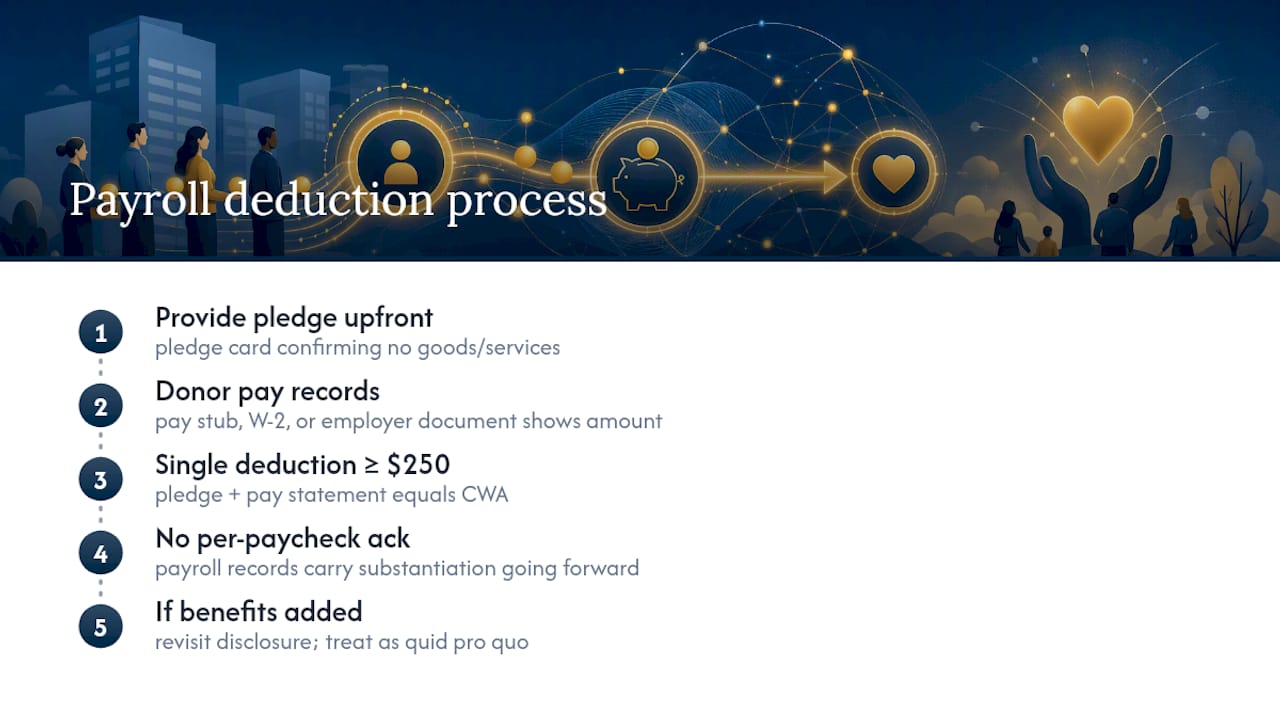
Payroll deduction contributions, common with workplace giving campaigns, follow a modified version of the CWA rule. A single pay stub, W-2, or other employer document showing the amount withheld for the charity counts as sufficient substantiation, as long as it’s paired with a pledge card or other document from the charity showing it doesn’t provide goods or services in exchange for payroll contributions.
For any single payroll deduction of $250 or more, that combination, the pay statement plus the pledge document, functions as the CWA. Your organization doesn’t need to issue an individual acknowledgment for each paycheck deduction. Instead, provide the pledge card or a written statement upfront confirming no goods or services will be given in exchange for gifts made through the program, then let the donor’s own payroll records carry the substantiation burden going forward.
This matters most for federated campaigns or employer-sponsored giving platforms, where hundreds of small deductions accumulate over a year. If your organization runs its own workplace giving program directly, rather than through a federated campaign administrator, you’re the one responsible for issuing that upfront pledge document. Get the wording right once, and it covers every payroll donor for the life of the campaign, as long as the terms don’t change. If your program later adds a benefit, such as event tickets tied to giving levels, you’ll need to revisit the disclosure and treat it like any other quid pro quo arrangement.
Split-Interest Gifts and Partial Quid Pro Quo Property
Split-interest arrangements, such as charitable remainder trusts, charitable lead trusts, and pooled income fund gifts, carry disclosure obligations that go beyond a standard CWA. Because only a portion of the transferred asset ultimately benefits your organization, the acknowledgment needs to reflect the present value of the charitable interest rather than the full value of the transferred property. Donors typically need this figure calculated by a qualified professional, since it depends on IRS actuarial tables, the donor’s age, and prevailing interest rates at the time of transfer.
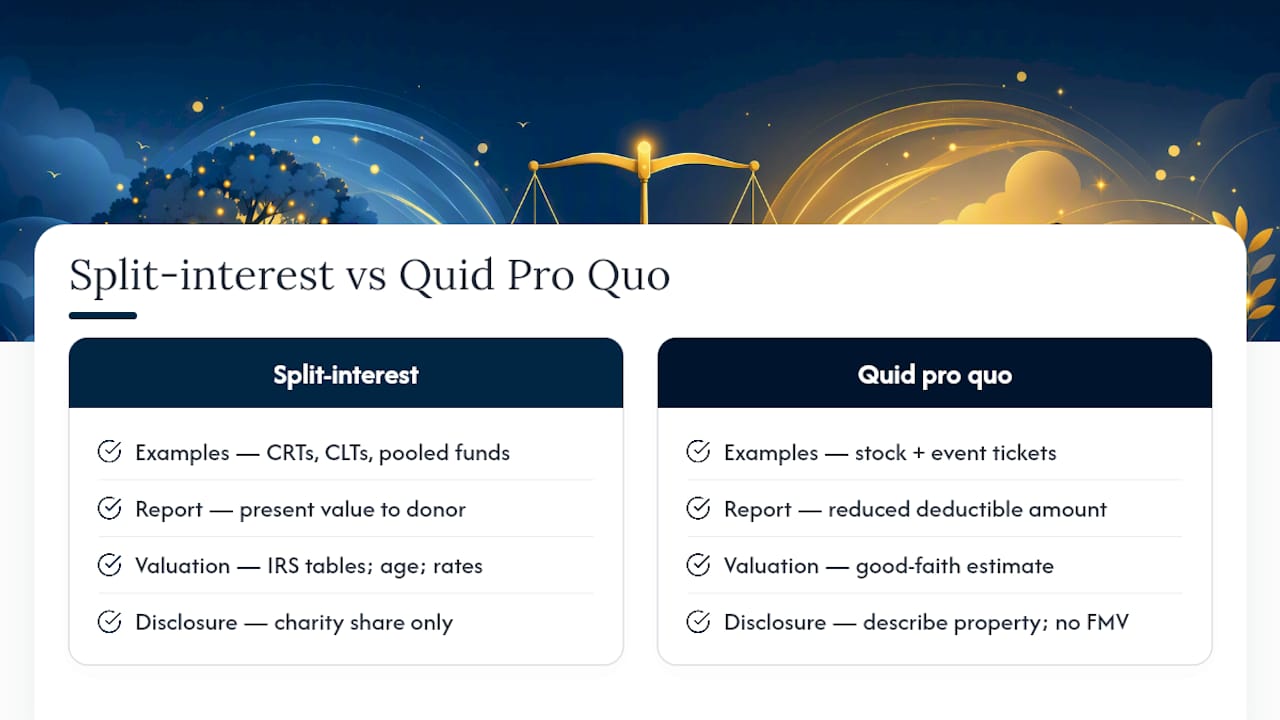
Noncash property that comes with a partial quid pro quo, say, a donor contributes appreciated stock but receives event tickets in return, requires layering both rule sets together. You still need the description of the property without a stated fair market value, but you also owe the same quid pro quo disclosure that applies to cash gifts over $75: a statement that the deductible amount is reduced by the value of what the donor received, plus your good-faith estimate of that value.
Get this wrong and donors risk overstating their deduction on a gift that was already partially non-charitable in nature. Any organization regularly receiving split-interest gifts or noncash property tied to benefit events should build a separate internal checklist for these transactions rather than forcing them through a standard cash-gift template. The stakes are higher, the calculations more technical, and the margin for error in the disclosure language considerably smaller.
Recurring Donors Need a Different Acknowledgment Rhythm
A monthly donor giving $25 a month crosses the $250 threshold by month ten, and that changes what you owe them. One-time gifts are straightforward: acknowledge the gift, confirm the amount and date, state whether anything was exchanged. Recurring gifts require tracking cumulative totals across the calendar year, since the CWA requirement applies per-donor, per-year, not per-transaction.
Two approaches work. First, send an acknowledgment after each individual gift, which satisfies the rule outright but can feel excessive for a $10 monthly donor. Second, issue one annual summary acknowledgment early in January covering all gifts from the prior year, which Publication 1771 explicitly permits as long as it reaches the donor before they file.
Most nonprofits with active monthly giving programs land on the second option. It reduces mailing costs, cuts down on donor confusion from repeated emails, and consolidates the entire year’s giving into one clean document the donor can hand to a tax preparer. Whichever method you choose, apply it consistently across your recurring donor base rather than mixing approaches, since inconsistent acknowledgment practices are one of the more common triggers for donor complaints during tax season.
Donated Services Don’t Get a Deduction Receipt
Volunteer time and professional services are not deductible contributions under federal tax law, no matter how valuable the work was or how many hours someone logged. A graphic designer who builds your annual report for free, an attorney who reviews a contract pro bono, or a volunteer who staffs your gala for six hours: none of that generates a deductible gift for the person providing it, and your organization should not issue a receipt implying otherwise.
Where it gets nuanced is out-of-pocket expenses incurred while volunteering. Unreimbursed expenses directly connected to volunteer service, mileage driven for a charitable purpose, supplies purchased for a nonprofit event, can be deductible to the volunteer, and those do warrant a written acknowledgment describing the services performed and confirming no goods or services were provided in return. The acknowledgment should never assign a dollar value to the volunteer’s time itself, only to documented out-of-pocket costs the volunteer can substantiate independently.
A good middle ground: send volunteers a thank-you letter that recognizes their contribution warmly, but keep any language about deductibility narrowly scoped to reimbursable expenses, and encourage them to keep their own mileage logs and receipts. That protects your organization from implying a deduction exists where the law doesn’t allow one.
Receipting Corporate and Foundation Donors
Corporate and foundation donors follow the same substantiation rules as individuals, since the Form 8283 and CWA requirements apply to any taxpayer, not just individual filers. The practical difference shows up in scale and documentation expectations. Corporate gifts are frequently larger, more likely to involve noncash property such as equipment or inventory, and often tied to matching gift programs or sponsorship agreements that include a benefit component.
When a corporate sponsorship includes recognition, such as a logo placement or event signage, determine early whether that recognition rises to the level of “substantial return benefit” that would trigger quid pro quo disclosure, or whether it qualifies as incidental acknowledgment that doesn’t reduce the deductible amount. The line matters, and getting it wrong on a $25,000 sponsorship carries more financial weight than on a $75 individual gift.
Foundations making grants generally don’t need charitable deduction receipts in the traditional sense, since grantmaking foundations aren’t claiming a personal deduction the way an individual donor would. What they typically want instead is a formal grant agreement and, often, a letter confirming your organization’s tax-exempt status and use of funds. Keep a separate template ready for institutional funders that emphasizes compliance and reporting over deduction language, since that’s what their own auditors will be looking for.
Why We Push Nonprofits to Formalize This Now
Every compliance issue we see at Chisholm Law Firm traces back to the same root cause: a nonprofit treated receipting as an afterthought until a donor called asking why their deduction got questioned. Formalized templates and a locked acknowledgment calendar prevent that call from ever happening.
Nonprofits that build this discipline early protect both their donors and their own credibility with funders who check for exactly this kind of operational rigor.
— Audrey K. Chisholm
Let Chisholm Law Firm Audit Your Receipting Process
Getting donation receipt requirements right consistently, across cash gifts, quid pro quo events, noncash property, and payroll campaigns, takes more than a template pulled from a search result. Chisholm Law Firm reviews your existing acknowledgment language, flags what’s missing, and builds compliant templates your staff can reuse without re-checking IRS rules every time a gift comes in.

Our work here typically follows three steps: a compliance audit of your current receipts and disclosure language, custom template drafting for cash, noncash, and quid pro quo scenarios, and staff training so your team can apply the rules confidently without legal review on every gift. We also guide organizations through the trickier Form 8283 and appraisal questions that come up with larger noncash donations.
If you’re unsure what a nonprofit attorney engagement costs or how to fit it into a lean budget, our breakdown of what a 501©(3) attorney costs and how to afford one walks through flexible options. Reach out to schedule a compliance review before your next major fundraising event or year-end giving push.
Sources
- Charitable Contributions – Substantiation and Disclosure Requirements, Publication 1771
- 26 CFR § 1.170A-15 — Substantiation requirements for charitable contributions